Sustainable Land Management in the Kingdom of Saudi Arabia
Introduction
The Kingdom of Saudi Arabia, located in an arid region with fragile ecosystems, faces high temperatures and very low, variable rainfall, exacerbating land degradation and desertification. A sector review indicated that 70% of rangelands, covering 73% of the Kingdom's land surface, are either severely or averagely degraded. Of the 1.18 million hectares of arable land used for agriculture (0.6% of Saudi Arabia's area), 40% suffer from salinity due to improper irrigation, and 67% from soil erosion. The review identified drivers of land degradation, including overgrazing, deforestation, unsustainable management of soil, water, and vegetation, industrial activities, waste disposal, mining, urbanization, climate change, and wild forest fires.
In line with its Vision 2030, Saudi Arabia aims to restore degraded lands and re-green vast areas of the country and the broader Middle East. The National Center for Vegetation Cover Development and Combating Desertification (NCVC) collaborates with the Food and Agriculture Organization (FAO) and the World Overview of Conservation Approaches and Technologies (WOCAT) to expand Sustainable Land Management (SLM) solutions. The jointly developed SLM Framework for Saudi Arabia consolidates efforts to provide a guide for implementing and scaling up SLM in Saudi Arabia, covering the assessment of land degradation processes and drivers, recognizing local and international solutions, documenting effective SLM practices, and supporting knowledge management, decision-making, and mainstreaming SLM efforts, thereby enhancing the adoption of SLM practices and strengthening the country's commitment to combating land degradation and desertification.
Framework for Documenting and Implementing Sustainable Land Management in the Kingdom of Saudi Arabia
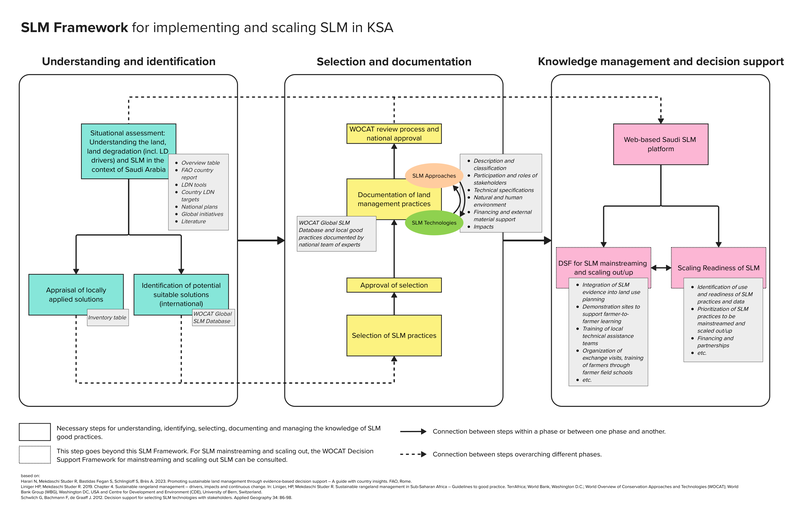
The SLM Framework for Saudi Arabia provides a systematic approach to addressing land degradation in Saudi Arabia. It includes steps for understanding the current state of the land, identifying effective SLM practices, and documenting these practices for wider adoption. By focusing on situational assessments, selection, and documentation of SLM practices, the framework aims to support sustainable development and improve the livelihoods of local communities, ensuring that land management practices are both effective and scalable.
Understanding and Identification
A thorough situational assessment is crucial for effective SLM implementation. This involves analyzing bio-physical and socio-economic aspects of the land, assessing land degradation processes, and identifying hotspots where degradation is most severe. By evaluating existing SLM technologies and approaches, the framework helps identify suitable solutions from both local and international contexts, ensuring that the most effective practices are adopted and scaled up.
Selection and Documentation
SLM practices are selected based on sustainability criteria, including social, economic, and environmental factors. Approved practices are documented using WOCAT's standardized questionnaires, ensuring quality and reliability. This documentation process helps preserve valuable knowledge and supports the replication and scaling of successful practices. By systematically selecting and documenting SLM practices, the framework ensures that effective land management strategies are accessible and can be implemented across Saudi Arabia.
Knowledge Management and Decision Support
A web-based Saudi SLM platform will serve as a central repository for documented SLM practices. This platform will facilitate knowledge sharing and collaboration among stakeholders, providing access to valuable information and resources. The integraion of concepts such as the Scaling Readiness Framework by Verbist et al. (2023) and Decision Support Framework (DSF) by FAO and WOCAT provides guidelines for mainstreaming and scaling out SLM practices, ensuring they are effectively integrated into national policies and land use planning. By leveraging technology and fostering collaboration, the platform aims to enhance the adoption and impact of SLM practices across the Kingdom.
The SLM Framework for Saudi Arabia sets the foundation for sustainable land management and environmental restoration. By implementing and scaling out effective SLM practices, Saudi Arabia can achieve its Vision 2030 goals, ensuring a sustainable and resilient future for its land and people. Continuous monitoring, adaptation, and collaboration among stakeholders will be key to the success of these efforts, paving the way for a greener and more prosperous Saudi Arabia.

Partners



WOCAT Contact

 Switzerland
 Switzerland
 Switzerland
 Netherlands
Documented Good Practices in Saudi Arabia