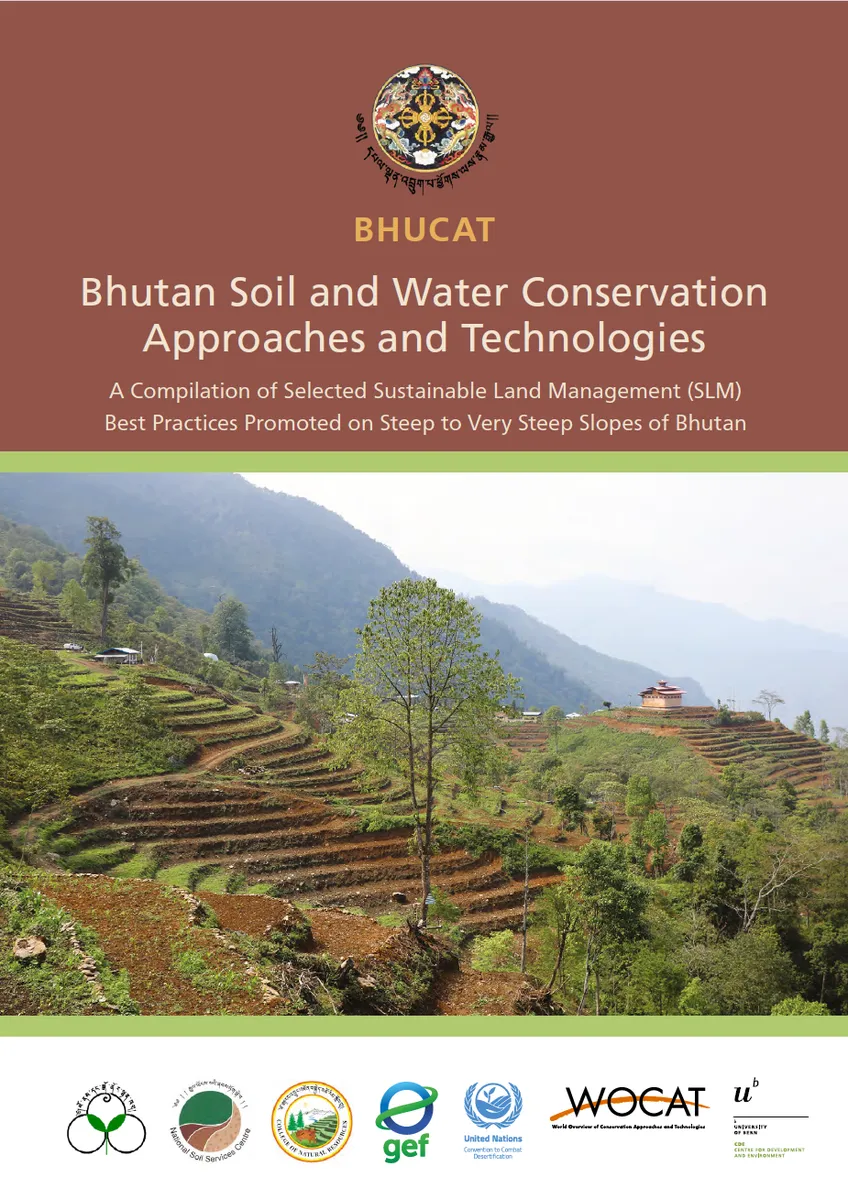
Bhutan Soil and Water Conservation Approaches and Technologies (BHUCAT)
A Compilation of Selected Sustainable Land Management (SLM) Best Practices Promoted on Steep to Very Steep Slopes of Bhutan
Soil and water conservation lies at the heart of Sustainable Land Management (SLM) in Bhutan. With more than 70 percent of our agricultural land located on steep to very steep slopes, farming communities face unique challenges in maintaining soil fertility, reducing erosion, and ensuring sustainability. Starting in 2005 until today, a wide range of conservation approaches and technologies have been promoted and adapted to Bhutan’s diverse agro-ecological settings.
The Bhutan Soil and Water Conservation Approaches and Technologies (BHUCAT) brings together these experiences into a single reference. It documents best practices – ranging from time-tested traditional systems rooted in local knowledge to innovative measures – that have been successfully applied across the country. BHUCAT serves not only as a technical reference, but also as a platform for knowledge sharing and capacity building. It offers practical guidance for farmers, field practitioners, planners, and policymakers in their pursuit of making decisions based on evidence and scale out good practices for resilient and sustainable land use systems.
Citation:
National Soil Service Center (NSSC) and World Overview of Conservation Approaches and Technologies (WOCAT), 2025. Bhutan Conservation Approaches and Technologies (BHUCAT). A Compilation of Selected Sustainable Land Management (SLM) Best Practices Promoted on Steep to Very Steep Slopes of Bhutan. National Soil Services Centre, Department of Agriculture, Ministry of Agriculture and Livestock, Royal Government of Bhutan, Semtokha, Thimphu; WOCAT and Centre for Development and Environment (CDE), University of Bern, Switzerland. https://doi.org/10.48620/92483