
Integrated Territorial Planning and Development Project (PADIT) [Tunisia]
- First published:
- 2023-09-18 09:51
- Updated:
- 2024-05-01 09:35
- Compiler:
- Wafa Saidi
- Editors:
- Ahmadou Gaye, faouzi BATTI, Faouzi Harrouchi, Fatma Maaloul, Siagbé Golli, Tabitha Nekesa
- Reviewers:
- Rima Mekdaschi Studer, William Critchley

Seed Cleaning and Treatment [Tunisia]
In Tunisia, ensuring a consistent supply of quality forage and pasture seeds to farmers is a critical hurdle in advancing the livestock industry, with many farmers turning to self-produced seeds to fulfil their requirements.
- Compiler:
- Wafa Saidi
- First published:
- 2023-09-19 08:50

Dry Stone Walls [Tunisia]
Dry stone walls are durable landscaping structures created by arranging stones to construct small walls (without cement or plaster) either following contour lines or approximately perpendicular to the slope.
- Compiler:
- Wafa Saidi
- First published:
- 2023-09-19 08:51
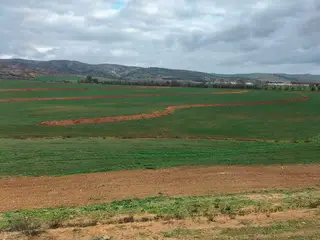
Mechanical Benches [Tunisia]
Mechanical bench terraces are a landscaping technique employed on sloping terrain. These are essentially mechanically constructed earthen levees or embankments established along contour lines.
- Compiler:
- Wafa Saidi
- First published:
- 2023-09-19 08:51

Individual Dry-Stone Basins [Tunisia]
Individual dry-stone basins are a traditional runoff water collection technique built in dry stone around the trunk of trees, mainly olive trees.
- Compiler:
- Wafa Saidi
- First published:
- 2023-09-19 08:50

Stone Lines [Tunisia]
Stone lines (or "stone barriers") are small structures aligned along contours. These reduce the velocity of runoff flowing down sloping land while capturing materials carried by the water. The stone lines gradually accumulate sediment which leads to the gradual creation of terraces.
- Compiler:
- Wafa Saidi
- First published:
- 2023-09-19 18:40

Contour tillage [Tunisia]
Contour ploughing is an agricultural technique involving the cultivation of sloping land along contour lines. This technique creates a succession of closely spaced ridges and furrows which help to retain water and soil.
- Compiler:
- Wafa Saidi
- First published:
- 2023-09-19 08:51

Meslin: Mixed crops of cereals and legumes [Tunisia]
Meslin consists of a planting mix of cereals and legumes, formulated for both livestock feed and soil rehabilitation purposes.
- Compiler:
- Wafa Saidi
- First published:
- 2023-11-22 11:20

Biological consolidation of mechanical benches with olive trees [Tunisia]
The biological consolidation of embankments is an agricultural practice that entails planting embankments with arboricultural, pastoral, or forage species. This cultivation technique enhances the effectiveness and longevity of these structures.
- Compiler:
- Wafa Saidi
- First published:
- 2023-09-19 08:51

Tabia [Tunisia]
The tabia earthen dyke is a water harvesting technique used in the foothill and piedmont areas.
- Compiler:
- Mongi Ben Zaied
- First published:
- 2017-03-21 15:34

Jessour [Tunisia]
Jessour is an ancient runoff water harvesting technique widely practiced in the arid highlands
- Compiler:
- Mongi Ben Zaied
- First published:
- 2017-03-07 08:57